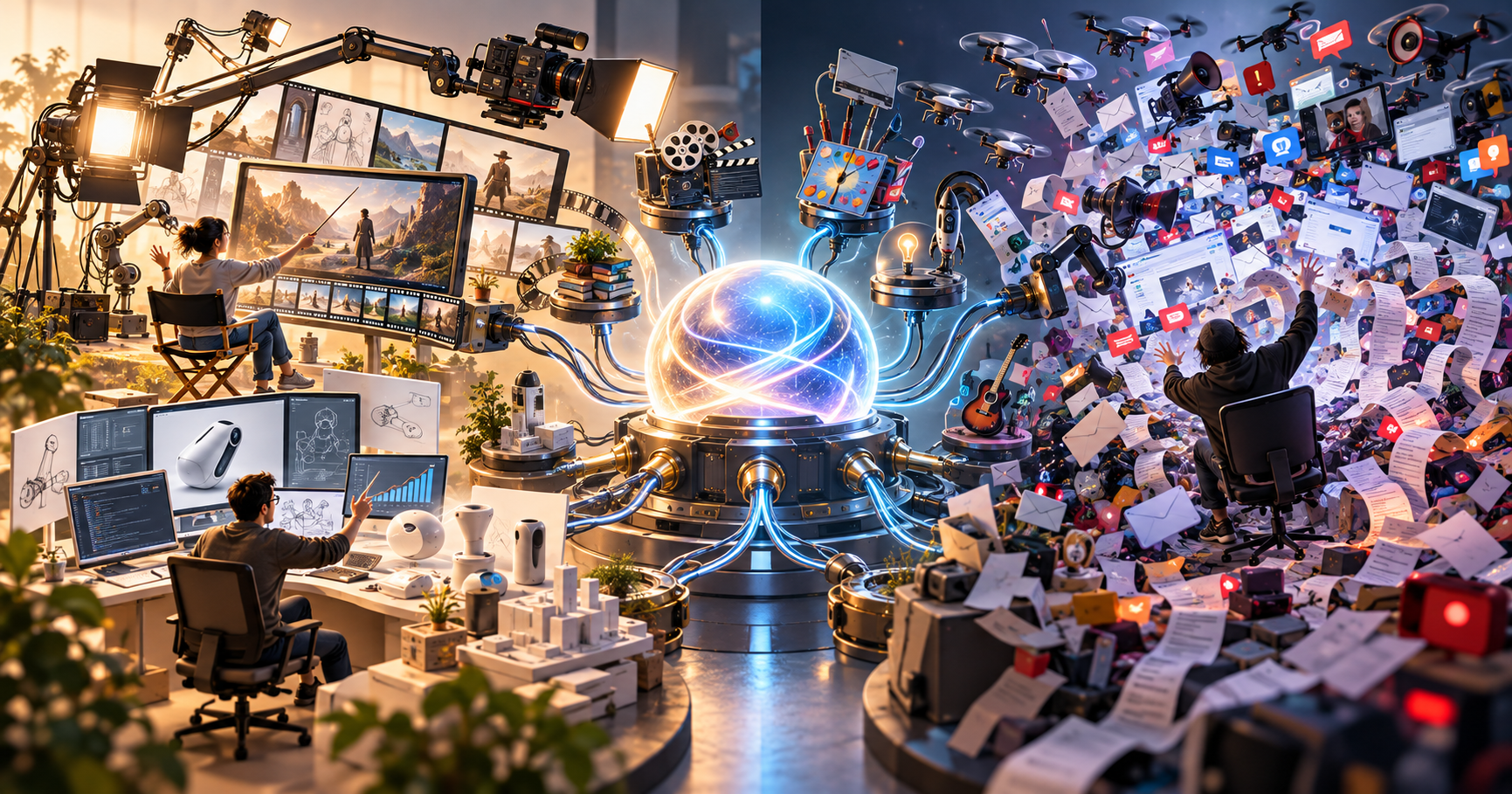

One of the most important AI stories right now isn’t really about creativity.
It’s about leverage.
AI is increasingly allowing individuals and small teams to accomplish work that once required much larger groups of highly skilled people.
That is one of the things I find most exciting about the technology.
It is also one of the things we need to think about carefully.
AI doesn’t only democratize filmmaking, coding and entrepreneurship.
It democratizes capability.
And capability itself isn’t good or bad.
It amplifies whoever is holding it.
One Person Can Suddenly Do Much More
A filmmaker can visualize scenes without a studio.
An entrepreneur can write software without assembling a large engineering team.
A small company can analyze information that once required an entire department.
That’s enormously empowering.
But the underlying force doesn’t distinguish between useful intentions and destructive ones.
A hammer can build a house.
It can also make you deeply regret leaving your thumb near a nail.
AI is obviously a slightly more complicated hammer.
But the principle matters.
AI Is an Amplifier
We often talk about artificial intelligence as though it is an independent force arriving in society.
In many cases, it is better understood as an amplifier.
It amplifies intelligence.
It amplifies productivity.
It amplifies creativity.
It amplifies reach.
And sometimes it amplifies bad judgment.
That means the same technology that gives one person the power to build something extraordinary can give another person the power to cause extraordinary damage.
The technology isn’t choosing.
We are.
And learning how to preserve the enormous upside of AI while limiting the downside may become one of the defining technological challenges of the next decade.