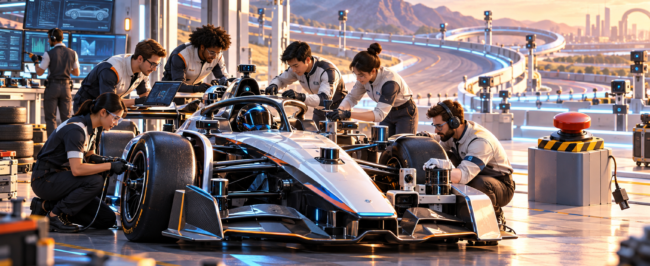

The AI development that fascinates me most isn’t a better chatbot.
It’s AI helping build the next AI.
We’re beginning to see AI systems perform meaningful portions of research, coding, experimentation and development work connected to improving artificial intelligence itself.
Follow that curve far enough and something profound happens:
Human beings are no longer improving the tool alone.
The tool begins helping improve the tool – this is new territory!
Which is both incredibly exciting and, if we’re being fair, exactly the sentence that usually appears about 20 minutes before things go sideways in a science-fiction movie.
But this isn’t science fiction.
AI-Assisted AI Development Changes the Feedback Loop
For most of technological history, tools have remained relatively passive.
A hammer never suggested a better hammer.
A camera didn’t redesign the next generation of cameras.
A computer could help engineers perform calculations, but humans remained firmly at the center of deciding how the next computer should be built.
AI introduces something different.
An AI system can increasingly assist with coding, testing, research, optimization and scientific reasoning.
That means the technology itself can participate in accelerating the development process.
And even modest improvements in that feedback loop could become enormously important over time.
This Doesn’t Mean Superintelligence Arrives Tuesday
There is a tendency in AI conversations to jump from an interesting technical development directly to the robot apocalypse.
That isn’t particularly useful.
AI assisting in AI development does not automatically mean uncontrollable recursive self-improvement.
There are still major technical, physical and economic constraints.
But the direction matters.
For most of history, our tools waited for us to improve them.
We may be entering an era where they increasingly participate in their own evolution.
That could accelerate scientific discovery in ways we can barely imagine.
It could also create entirely new questions about control, oversight and the speed of technological change.
I’m incredibly excited by that.
And just uncomfortable enough to think we should be paying very close attention.